

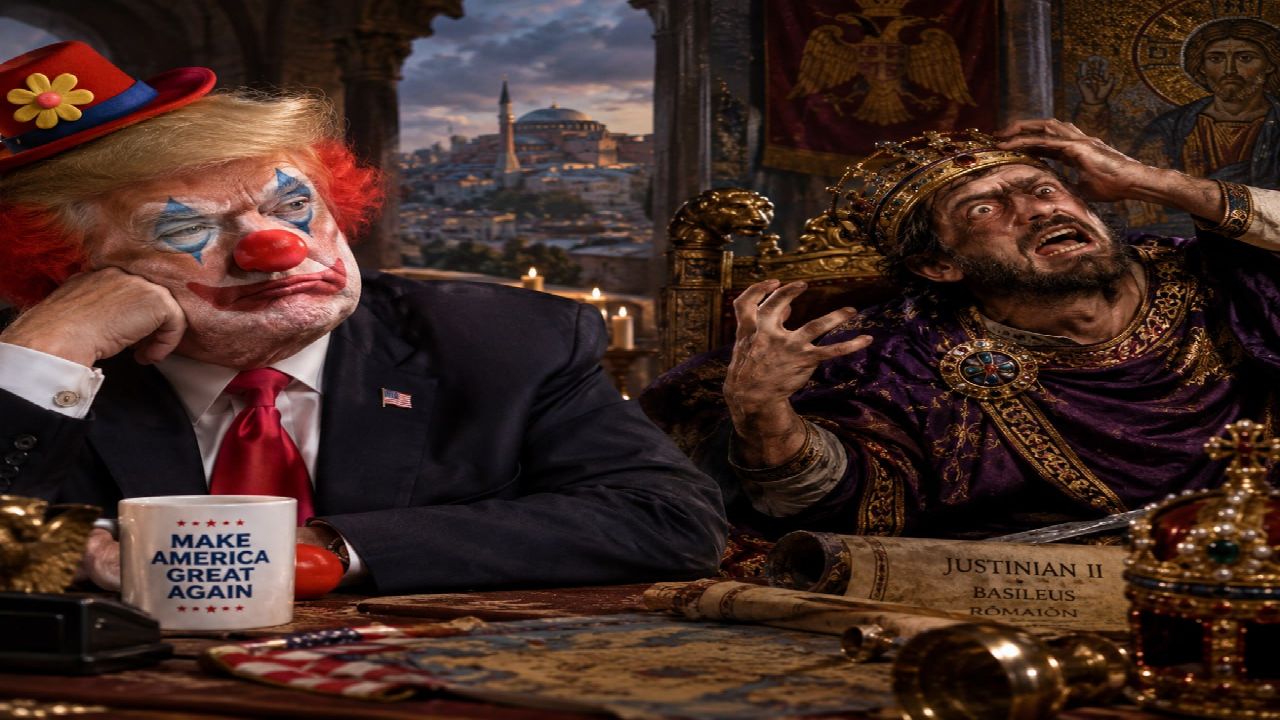
Byzantium offers a stark lesson for those willing to look beyond palace intrigues, warring factions, and the shifting line-up of rulers: the fate of an empire rarely hinges solely on the individual wearing the crown.
The Eastern Roman Empire survived for nearly a millennium after its Western counterpart collapsed. It weathered coups d’état, civil wars, incompetent rulers, religious schisms, and devastating military defeats. While some leaders consolidated the state, others drove it to the brink of ruin. Yet, through centuries of turbulence, the imperial machinery kept running.
The reason was systemic. Beyond the emperor stood a deeply entrenched bureaucracy, a foundational legal tradition, and a capital that centralized both economic and political power. It boasted a diplomatic corps skilled at turning adversaries into partners, and an elite acutely aware that state survival was the prerequisite for their own status.
An emperor could blunder, but the empire possessed institutional guardrails to limit, offset, or simply outlast his errors. Not always, of course. Byzantine history is littered with decisions that caused irreversible damage. Yet it is precisely this tension between systemic vulnerability and resilience that makes the Byzantine model so relevant to contemporary global power.
Today, Washington demands analysis through that exact same lens.
Granted, the United States is not Byzantium. It has no emperor, and its constitutional design, democratic society, and mechanisms of political legitimacy are fundamentally different. However, if “empire” is understood in a geopolitical rather than a strictly territorial sense, a vast American power structure clearly emerges far beyond its domestic borders.
This global architecture relies on military alliances, strategic forward bases, the financial supremacy of the greenback, international institutions, trade frameworks, technological dominance, and deep economic interdependencies. Washington does not directly control every moving part. Yet this is precisely where the resilience of the American system lies: its power stems less from unilateral edicts issued by the White House, and more from the dense networks of shared interests built over decades.
A president can shift diplomatic rhetoric, threaten partners, reset foreign policy priorities, and inject volatility into economic ties. But a military alliance is far more than a personal rapport between world leaders. It is cemented by shared infrastructure, long-term procurement contracts, joint strategic planning, operational interoperability, and binding legal commitments—national interests that do not evaporate when a new occupant moves into the Oval Office.
Similarly, the dollar’s global hegemony does not rise or fall on presidential speeches. It is anchored by the sheer scale of the U.S. economy, unmatched financial market liquidity, and the daily decisions of millions of global economic actors. While these mechanisms are not indestructible, they cannot be dismantled by executive decree alone.
This is the core parallel with Byzantium: a geopolitical system can carry enough institutional inertia to withstand a leader who tests its limits. However, inertia should not be mistaken for invulnerability.
Byzantine history also charts the reverse trajectory. When domestic infighting drained public resources, central authority fragmented, and defense was increasingly outsourced to external actors, the empire’s geopolitical agency collapsed.
By the 14th and 15th centuries, Byzantium had ceased to dictate the political rhythm of the Eastern Mediterranean. It retained its prestige, diplomatic finesse, and an impressive imperial pedigree, but its material and military baseline had withered. Prestige could no longer compensate for structural decay, and Constantinople fell in 1453.
The takeaway is not that all empires share a predetermined expiration date, nor that the U.S. has reached a late-Byzantine stage. Drawing such direct lines reduces history to mere fortune-telling. The real lesson is simpler and far more sobering: institutions can absorb a leader’s missteps, but they cannot indefinitely neutralize their cumulative weight.
An empire can weather a presidential term that damages specific interests. It can absorb friction, redistribute costs, and maintain institutional continuity despite erratic policy shifts. Yet every crisis exacts a toll—measured in eroded trust, diminished diplomatic leverage, weakened negotiating power, or a growing reluctance among allies to anchor their future to the imperial center.
Allies who lose faith in Washington’s predictability do not abandon the system overnight. Instead, they quietly hedge their bets, investing in domestic defense capabilities and negotiating alternative partnerships. This structural adaptation rarely triggers an immediate rupture, but it gradually reshapes the dynamics of dependency.
This is the primary strategic hazard of an unpredictable foreign policy: it saps the strength of alliances without needing to formally break them. When partners conclude they can no longer rely solely on the center, the long-term fallout outlasts any single administration.
This phenomenon has a parallel economic dimension—less visible than troop withdrawals or frosty diplomatic summits, but potentially more damaging over time. When the periphery begins to doubt the center, it shifts not just its strategic alignments, but also its capital, supply chains, and economic security frameworks. Capital prioritizes predictability, which is no longer a monopoly of the imperial core.
If allies begin onshoring industrial capacity, diversifying trade partners, and building alternative financial architectures, the economic activity that once fed the center migrates to the periphery. This shift does not necessarily trigger an immediate collapse of the domestic economy, but it steadily erodes its relative advantage.
Here too, Byzantium is instructive. Constantinople built its hegemony partly as a commercial, financial, and administrative hub that extracted and redistributed wealth across vast territories. However, as the state lost control over trade routes and granted sweeping concessions to Venetian and Genoese merchants, the economic dividends of trade shifted beyond imperial control. While economic drift alone does not explain the fall of Byzantium, it highlights a fundamental truth: a capital can retain its prestige and institutional trappings even as it loses its grip on the material flows that sustain it.
In a modern imperial context, the trajectory looks similar. Washington may well remain the political and military hub of the West, but if its allies redistribute investments, industrial assets, and financial networks, the underlying economic power that projects American influence will drift outward. When wealth and resources are no longer concentrated at the core, the ability to dictate terms can no longer be taken for granted.
In this environment, the crucial question is not whether American institutions can block every controversial presidential initiative. The real question is whether the U.S. political system possesses the corrective mechanisms needed to cap the strategic costs of these decisions, and whether those guardrails move fast enough. Congress, the judiciary, the federal bureaucracy, the military, the private sector, and the electorate act as distinct checks and balances. Yet they do not operate as a perfectly synchronized machine; their efficacy depends on statutory powers, shifting political alignments, and the specifics of any given crisis.
Furthermore, institutional resilience can yield a dangerous paradox. If the system manages to keep running, a leader may misinterpret that survival as validation, assuming their policies carry no major costs. In reality, the structural bill often comes due years later, when the damage is far more expensive and complex to fix. The empire endures, but it is fundamentally altered in the process.
This underscores a distinction routinely overlooked in public discourse: state stability is not synonymous with foreign policy success, just as the survival of an alliance does not mean mutual trust remains intact. A country can possess functional institutions alongside deeply flawed strategic policies. It can boast a powerful economy even as its diplomatic capital depreciates. It can preserve a network of alliances while its partners actively prepare for an era of American unpredictability. An empire can appear stable simply because the architecture built by predecessors is robust enough to temporarily absorb a current leader’s errors. But that capacity has a ceiling.
Byzantium stands as a reminder that prestige, tradition, and institutions are no substitutes for hard resources, military readiness, and political cohesion. The United States offers a contemporary variation: a superpower whose global leverage depends not just on executive decisions in Washington, but on whether the rest of the world views the American system as useful, legitimate, and reliable. While the two empires are not historical clones, they face the exact same fundamental question: how long can a system offset the blunders of the core before those blunders permanently alter the system itself?
The answer will not be found in a leader’s temperament or the daily political theater. It lies within institutions, resource management, core interests, and a state’s capacity for self-correction before erosion becomes irreversible. When a leader stumbles, the empire can hold the line. But when those errors harden into permanent policy, “stability” becomes nothing more than a euphemism for a slow-motion crisis whose full impact has yet to hit.
Ultimately, regardless of how polarizing Donald Trump remains or what questions were raised by Joe Biden’s age and executive stamina, America’s trajectory cannot be reduced to the personality in the Oval Office. A mature power must not rely on the providential arrival of a flawless leader; it must depend on the capacity of its institutions to mitigate errors, pivot away from failed policies, and manage political transitions without the entire edifice fracturing.
History, however, offers no guarantees of automatic self-correction. It requires leaders who recognize that power is a temporary stewardship, not a personal trophy, and that long-term strategic interests cannot remain permanently decoupled from the expectations of the electorate.
This exposes the defining dilemma of modern American governance: drawing the line between a necessary social safety net and the expansion of an inefficient bureaucracy that consumes resources without producing results; between national solidarity and systemic state dependency; between vital public investment and administrative waste. Not every social program equates to socialism, just as deregulation does not automatically unlock prosperity.
Yet no global power can indefinitely ignore mounting fiscal pressures, eroded purchasing power, economic insecurity, and a pervasive public sentiment that institutions serve their own self-perpetuation rather than the common good. A leadership capable of recalibrating individual accountability, economic dynamism, and targeted support for the vulnerable, all while cutting waste and addressing legitimate populist grievances, can restore public trust. This requires verifiable structural results, not nostalgia for an idealized past.
This capability separates an empire trapped in its own structural contradictions from one still capable of charting a new course. America does not require an infallible executive. It needs leaders who respect the limits of their office, honor institutional norms, and understand that true legitimacy is built not through political theater, but through the efficient conversion of public resources into security, opportunity, and shared prosperity.
Should that caliber of leadership emerge, the American system retains the capacity to self-correct. Without it, institutions may prolong the nation’s endurance, but they cannot guarantee its long-term renewal. Empires do not always collapse when their leaders become erratic or inept; often, the decline begins when the ruling class forgets why the system was built—and whose interests it was designed to serve.
~Editor’s note: This is a translation of the article published in Romanian as Împăratul și Imperiul nu sunt tot aia


