


Hungary is (was?) such an aUtoCRacY that Friday night, April 10th, a quarter and up to half of the inhabitants of the city of Budapest (yours truly included for the time being) couldn’t sleep due to the “change of the Regime” festival/concert that was held without incident or any frustration of any kind from the supposedly autocratic regime.
Besides, we all know that this is how autocracies fall, by being voted out of power and the autocrat conceding defeat even before all the votes have been talied.
I’ll be back with exclusive footage and more comprehensive analysis in a few days but, until then, a few key aspects are worth mentioning as you are all being bombarded with straight up lies and copious amount of disinformation and bad faith takes from the usual suspects on all sides – from the ordoliberals of the EU to the psychiatric hospitals of both the far-left and the far-right and ending with the paid shills (including the Budapest-based think-tanks whose activity is, granted, hilarious to observe these days).
The following ten things are true regardless of what anyone tells you:
- Magyar Péter is NOT a liberal. He is certainly not an economic liberal (no mainstream Hungarian politician is) and it is really debateable whether he is a social liberal. He is certainly not a progressive though.
- Magyar Péter IS pro-EU light. Or, if you want, he is just as pro-EU as Orbán is. Don’t believe me. Look up FIDESZ’s voting record in the European Parliament. Friendly reminder: Ursula von der Leyen owes her current position to the decisive votes provided by the FIDESZ delegation. The new prime minister is no different in practicality. He will have a wider smiley face while dealing with the Commission though.
- Magyar Péter IS NOT pro-Ukraine. For those who are happy with the result in Baszdmegország on geopolitical grounds, I have bad news for you. It may be 3 months, six or 24 months. But you will regret Orbán eventually. Magyar Péter’s stance on the northeastern neighbor is even harsher than FIDESZ’s, except he has a smiley face while uttering it.
- Magyar Péter IS a product of FIDESZ, for better and for worse. Mostly for worse, though. Because he’s more emotional, less patient and is surrounded by hungry people (and I mean that very literally). The shape of the State corruption will change, but the fundamentals are unlikely to change.
- TISZA Party (Tisztelet és Szabadság Párt) IS NOT a new political party or even a party in the traditional sense, even by Hungary standards. Hungary avoided the phenomenon that swept this region from 2016 to 2020-21. What phenomenon? It was called Zuzana Čaputová in Slovakia, USRPLUS in Romania, Sluha Narodnu in Ukraine and ITN (There is such a people) in Bulgaria. TISZA is closer to that kind of “party” – an amalgamation of disparate groups who are unified by “fuck the big guy” animus but are otherwise competing factions. TISZA Party got a 2/3+ majority at Kossuth Lajos tér but maintaining the unified front is very unlikely.
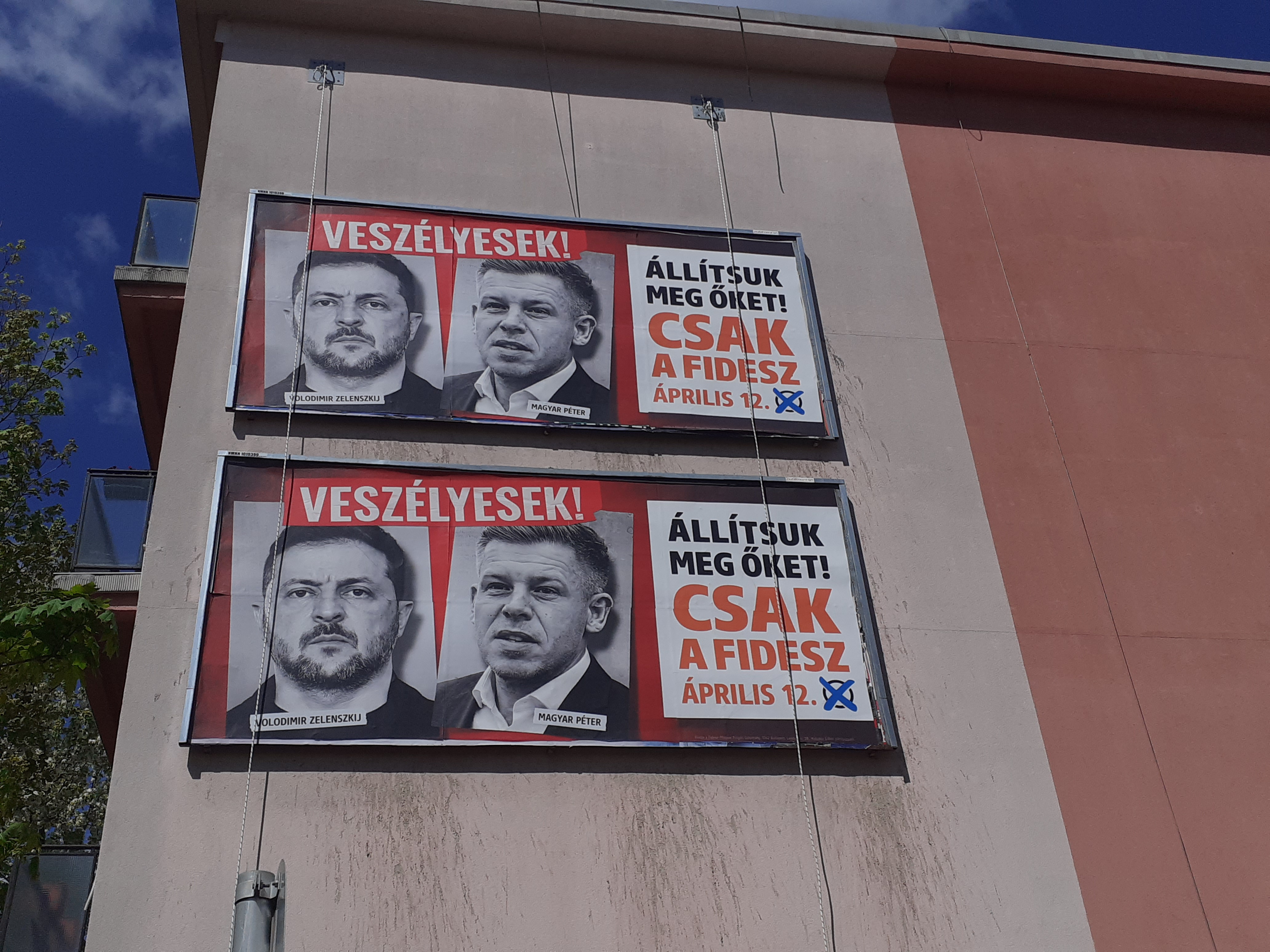
- FIDESZ deserved to lose. Maybe not by this margin, but it is a good thing that they lost. They ran a shit-tier campaign that had very little to do with the concerns of the Hungarian voters. We can speculate what those concerns were/are, but one thing is certain: It was not Zelenskyy. There were more Zelenskyy posters allover the country than in the 2019 presidential campaign in Ukraine itself which Zelenskyy/Sluha Narodnu won. If I hadn’t known better, I would’ve assumed Zelenskyy was on the ballot. Suffice to say this tactic didn’t pay off for FIDESZ.
- Recession will continue until morale improves. In fairness, the vast majority of the TISZA voters that I got to speak with didn’t expect any improvement on economics anytime soon. But lots of foreign observers noticed (correctly) how terrible Orbánomics has been for this country and went on to assume (incorrectly) that Peter the Hungarian can be/is a solution. He is not. And anyone telling you otherwise is full of it.
- Everyone had the polling wrong. Of course, nobody will admit that because it’s shameful. It also helped that Medián got it right purely by accident (shit-tier methodology, sheer luck after being wrong at least 5 times in a row by now) so it’s a good excuse for everyone to continue to avoid facing the problem. And the problem is that the old model is dead. Fidesz’s internal polling was wrong, Tisza’s internal polling was wrong, virtually all public consumption polling was wrong and the sociological data from the exit polls is straight up garbage. Political consultants, sociologists and polling companies better start paying attention. Or go bankrupt. I don’t really care either way. But don’t be shocked if you will continue to be wrong.
- This election had the highest rate of foreign interference in all of Hungary’s post-communist history. This is neither good, nor bad. It just is. It was usually like 5-6 foreign agents per campaign. This time around there were hundreds, unironically. Not just for TISZA, but for Fidesz, Mi Hazánk and even DK had foreign consultants and help. I wouldn’t be shocked if even MKKP had one or two foreigners in their campaign. And the voters knew that too. Approximately nobody was shocked about it. Certainly not the voters I got the chance to talk with. Maybe with the exception of the unusually excited TISZA voter I met in the night of the election who was a bit surprised I knew more details about Hungary’s nitty gritty politics than he did. After fact checking me on his smartphone 4 or 5 times he concluded I’m a weirdo for knowing so much. A conversation with the average voter truly is the best argument against democracy.
- There shouldn’t be any “earthquake”. Lots of foreign press framed the outcome as an “earthquake” for the Right more broadly and some corners of right wing internet even took that seriously. In reality, the only ones pushing this angle are left-wing shills (who are interested in demoralizing narratives, of course) and terminally online kids for whom 2022 is “a long time ago” and thus 2010 is “forever” ago. In the real world, grifts end, eventually. The current iteration of the FIDESZ grift is over. Meet the new boss, same as the old boss.
There is no fundamental political lesson to be drawn from here that applies to other campaigns elsewhere in Europe, let alone elsewhere in the world. And the shills who tell you otherwise are too close to the typical American who can’t fathom the existence of politics anywhere else without somehow being connected to the marginal squabbles of Burgeristan’s politics. JD Vance’s visit made literally no difference. It didn’t harm FIDESZ, but it didn’t help either.
There are however some cultural and technocratic lessons to be drawn from this campaigns. Such as:
- The opinion of Americans is now worth very little. JD Vance maybe moved 10,000 votes, and that’s being generous. FIDESZ earned over 2.5 million votes and maybe the VP’s visit increased morale a bit and maybe some lost case of Trump Derangement Syndrome got reminded that there’s an election on the 12th and went to vote for TISZA as (s)he was reminded of it by JD Vance’s face. But, by and large, it made little difference.
- The same can be said about the enthusiastic campaigning by Manfred Weber and other Brussels insiders. Btw, in case you forgot, Peter the Hungarian is also a Brussels insider.
- More broadly, the public (not just in Hungary, but also in Poland and Romania as evidenced by the presidential campaigns in 2025) has already priced in foreign interventions and endorsements. This is neither good nor bad. It just is. Accept it and move on. The next campaigns should rely less on these.
- Social media is fake. This has always been true but from 2014 to 2020 one could legitimately claim that enough votes can be moved via social media shilling in a tight race. In 2026, this is simply no longer true. Slopification, algorithmic enshitification and the ease with which Vietnamese/Indian posters can be bought and engaged has made social media useless as a metric. And that’s before even opening the discussion about disinformation, panic porn and all the other ills of contemporary social media. FIDESZ relied on social media a bit more while TISZA relied on touring the country several times a bit more. The latter was clearly a winner, just like it was the case with Karol Nawrocki in Poland or with both finalists in the Romanian presidential election and just like it will be the case at the end of this week for Rumen Radev’s political project in Bulgaria (which incidentally will also leave the westoid progressives outside of the Parliament – but that’s a story for another day).
- Large political machines are in deep trouble everywhere. TISZA is just the latest in a very long streak of political startups that rise fast. Vox, Chega, Ima Takav Narod, Sluha Narodnu, Gibanje Svoboda, Alianţa pentru Unirea Românilor, Partidul Acțiune și Solidaritate or Svoboda a přímá demokracie are examples that literally didn’t exist in January 2015 and by now have all been in government or will be in government by 2030. If we add Fratelli d’Italia (founded in 2012) or Vazrazhdane (founded in 2014) or Syriza (founded in 2013), the list of political projects that rose fast bypassing the large political establishments that they defeated becomes quite impressive. And by 2030 that list will be even more impressive. Because the new rulebook is being written as I’m writing these lines and as you’re reading them. By 2032 elections will be fought on rules that haven’t even been written yet. You can choose to internalize this and adapt or you can stay stuck in 2019 and hope for the best. The latter option eventually leaves you outside of politics, though.
That’s it for now. Given how slow the Internet is even in Budapest, and given how slow my laptop is, there’s simply no way I can edit videos. And, besides, now that Peter the Hungarian won, I’ll have to make good on the promise to come back here in June. And preparing that also means some extra errands to run in the Hungarian capital.
See ya soon. Cheers.

