
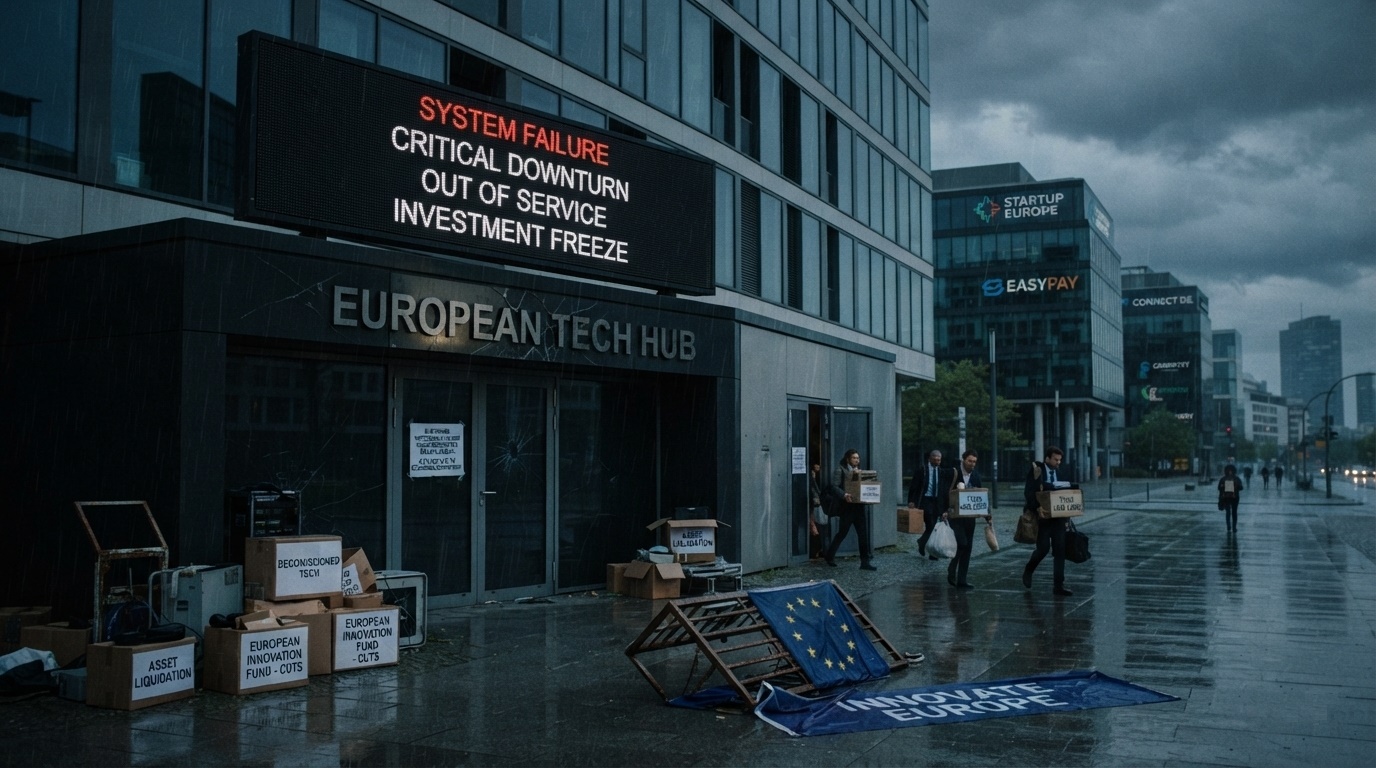
The main culprit of European tech being subpar is Brussels regulations. Not just GDPR (although that is bad enough in its own right), but also the general capital environment. And the proposed “solutions” are also in bad faith as they attempt to solve a problem that somehow didn’t exist 20 years ago or even 10 years ago.
For the last 30 years, and especially the last 20 years, American companies have been systematically destroying European tech products, aided by the US’ ZIRP (Zero Interest Rate Policy) but also taking advantage of the Europeans’ own regulations which not only made success hard, but has been making it even harder over the last decade.
Politicians from Europe sometimes claim that it’s sabotage, even though there’s nothing covert or hidden in what has been happening. Americans like to claim that it’s because of their superiour financial environment, which is a claim that is slowly collapsing under its own weight as the limitations of ZIRP are slowly becoming apparent.
The story of European lack of tech success is not one of American superiority or European inferiority. It’s a story of American grift, European corruption and users’ obliviousness. The latter is also politically incorrect to mention, but it plays a much larger role than anyone is willing to consider.
- Concrete examples (lots of them)
- European policy fault
- Users’ fault
- Addendum
Concrete examples
The common say that the plural of anecdotes doesn’t make it data is routinely used to shut down a conversation. It is true in general that the plural of anecdotes doesn’t necessarily mean it’s a trend or a pattern. However, when it happens exclusively in one direction and it’s also very politically connected, it becomes a lot harder to ignore the phenomenon.
The following examples follow the same pattern: European good or very good product emerges => gets bought by a US conglomerate => the product turns to shit/becomes bloated/becomes excessively expensive or is simply killed off to favor a more expensive American option. And in some cases the product is turned into an actively harmful one to serve unknown interests.
AVAST
Avast Antivirus is the most telling example of this phenomenon. Founded by Eduard Kučera and Pavel Baudiš in 1988, it’s a story of post-communist engineers making it big with the new found freedom. The founders met each other at the Research Institute for Mathematical Machines in Czechoslovakia. The initial company was founded as a cooperative under communism (the commies tried some market-ish reforms in an attempt to preserve the regime).
Avast is responsible for the first antivirus program ever for Windows 95 (and therefore for Windows as everyone reading this understands the operating system).
The founders tried really hard to avoid this path. They rebuffed attempts at being acquired by American conglomerates from 1995 and until 2014. But from 2010 onwards (when they allowed multinational capital), the company was under constant attack with multiple attempts at turning it into a grift. The founders caught up on some of them – such as in 2012 when they fired the outsourced Indian customer support team after they found out that iYogi was using misleading sales tactics to persuade customers to buy unnecessary services. Think of how rare that is.
That kind of integrity had to be punished. And it was. By 2013 Avast had over 200 million users and 350 employees. Soon after the share of foreign (overwhelmingly American) ownership increased and, with it, the enshitification of the product and the direct harm to customers. Outwardly, it was still the same product while de facto new management was merely skinwalking the logo while implementing a large spyware operation.
From 2014 (and allegedly until 2020), Avast sold their users’ browsing history while telling them it was protecting their privacy. And it wasn’t just browsing history either. It was data on their users’ financial status, political viewpoints, and health concerns. Even after being sued and paying a huge fine to the FTC, Avast continued to maintain that the data was anonymized, even though there is no evidence that that was the case and plenty of evidence that it wasn’t.
Avast ran a subsidiary called Jumpshot. This sub-company packaged that browsing data and sold it to over 100 third parties, advertising companies, marketing firms, data brokers, investment conglomerates. The data included every webpage every single user visited, exact timestamps, device and browser type, city, state, country and a unique persistent device identifier attached to every user’s profile. And it wasn’t just Avast users. In 2016, Avast acquired AVG (another Czech antivirus) and those users were also spied thereupon. From 2018 onwards, when the company was finally listed, the number of direct beneficiaries of spy data also increased several times over.
In total, at least 8 petabytes of data were sold. That’s almost 8,400,000 gigabytes. Or 16,000 years of music. Or a bit over 3,200,000,000 photos. All of it private data.
You wonder how the algorithmic enshitification happened? That’s how it happened. Through mass stealing of data from credulous users who entrusted their data to credible companies which were then gobbled up by mostly Silicon Valley conglomerates which operated under an infinite money glitch thanks to 15 years of ZIRP.
After the scandal from 2020, the company is re-sold to another conglomerate, relisted under a new name and in 2024 it pays a meager fine for the whole debacle. The fine was worth less than the data sales in a single month.
Skype
Remember Skype? It was officially killed in 2025.
Skype was an Estonian company launched in 2003. It was bought by eBay in 2005 in the hope to integrate it with broader e-commerce. That didn’t quite happen but the product remained a very good one and was even improved on the edges. That’s because Pierre Omidyar of eBay is still ultimately European.
Skype’s nightmare and walk through the valley of death starts with it being acquired by Microsoft. It was happening in 2011. Microsoft made no secret about why it was willing to spend that much on Skype: To block competitors and to put Microsoft in a dominant position in VoIP technology (cloud telephony).
After acquiring it, Microsoft made no effort whatsoever to maintain the product. While pretending to try to integrate Skype into its own eco-system, in reality Microsoft ran experiments on Skype users and used the result to develop Microsoft Teams which is effectively a far worse version of Skype but one that can be used for the grift corporate users.
In 2026, there is no reliable European product to do a conference call. There’s either the CCP spyware Zoom or the Burger Spyware “Teams”. Both suck bigly and everyone is far worse off.
Romanian AntiVirus (RAV)
GeCAD SRL is not a name many remember today. But that company produced an antivirus software from 1994 till 2004 that never really got replicated.
In addition to also offering Linux solutions (unheard of in those times, and still rare today), RAV was doing something no other antivirus did: It was actually removing desktop viruses while preserving your files. If you had important executable files that got infected by a self-replicating desktop virus, the standard “solution” was to either format your entire hard drive or delete every single executable file from your system and then manually restore them from CDs or other non-infected sources. RAV was actually capable of removing just the virus from a file and restoring the original file to its pre-infection state.
Got bought up by Microsoft in 2003, killed off as a product in 2004 and the ability to micromanage files to remove only the infected part was permanently shelved by Microsoft.
The Microsoft product that used RAV technology, Windows Defender (now Microsoft Defender) intentionally did not have the same feature because that would have incentivized users to stay offline, thus conflicting with Microsoft’s goal of continuous surveillance.
Also, the way RAV was built made the grift model (SaaS) impossible for its solutions which, again, was a threat to the grift.
Ivona (text to speech software)
Łukasz Osowski and Michał Kaszczuk started working in 2001 at a text to speech software that would actually sound natural, with lifelike human intonation, phonetics, and emotional cadence, as opposed to the robotic, routinely English-centric (and therefore wrong) TTS software at the time.
By 2006 IVONA was the standard for its field. Unlike everyone else, Ivona would generate speech that actually sounded human and unlike American solutions, it would actually read Michał Kaszczuk correctly (unlike even 2026 American solutions for text-to-speech).
It became an indispensable tool for the blind and visually impaired, e-book listeners, video creators, and developers. There was no number 2 on this. And all at a fraction of the cost too! So it had to be destroyed.
The executioner was Amazon Inc. The tech itself was too useful but it couldn’t be left as it was: namely a standalone locally-run independent software. You can’t grift with such thing! Unacceptable in America.
So, instead, Amazon slowly but systematically choked out the consumer and developer ecosystem that built IVONA. They stopped updates for the standalone Windows software, pulled individual voice licenses from the open market, and shut down the consumer-facing Ivona website. What remained of IVONA’s developer API was stripped down, re-architected, and rebranded as Amazon Polly, a cloud-based business service.
For years, video creators, indie game developers, and visually impaired users who relied on IVONA’s desktop apps begged Amazon to keep supporting them. Instead, they watched a highly customizable, locally-run software become entirely locked away inside Amazon’s corporate ecosystem.
The voice tech was mildly improved to build automated STASI for customers, also known as Alexa. Yet another useful product turned into spyware and grift!
Viewdle
If you’re too young, you probably never heard of this. The reason your Android phone is able to do face-unlocking, image searches, and automated photo grouping is because Google killed off a Ukrainian product in 2012 by lying through its teeth when it acquired it.
In 2006, long before Apple or Facebook perfected face-tagging, Viewdle created in Kyiv, Ukraine, the world’s only commercially viable, real-time, cross-platform computer vision engine. They built consumer apps like SocialCamera and augmented reality games like ThirdEye. Their software could look through a smartphone camera and detect who a person was instantly and not after uploading the photo to a server, but right on the edge device itself.
In other words, it was proof that these things can be done with full privacy protection. But, you see, there was a problem: it also proved that Silicon Valley grift was not mandatory. So Viewdle had to be killed.
In 2012 Google bought it through hostile takeover using an inconspicuous subsidiary named Motorola Mobility. To make things worse, the founders barely made any money from this thanks to another two American companies’ maneuvering, namely Qualcomm Ventures and BlackBerry Partners Fund.
Within two years Google shut down the R&D office in Kyiv and refused to continue to work with the original developers unless they moved to Burgeristan. Most chose not to.
The product itself was memory holed. It’s as if it never existed. What lives on is Google’s “native” option which is slower, far less secure and grifty by default.
The only silver lining is that Ukrainian techies learned to never trust Silicon Valley. That’s why Grammarly did not become yet another spyware tool.
Apiary
Unlike all the previous examples, this Czech software wasn’t meant for the masses, but for developers.
Apiary was gearing up to be an exception to the rule: An European piece of software that thrives due to excellence and is not killed. Well… it was killed eventually.
Founded in Prague in 2011 by Jakub Nešetřil and Jan Moravec, Apiary set out to solve a massive headache for software developers: building, testing, and documenting Application Programming Interfaces (APIs).
Before Apiary, documenting APIs was a chaotic, manual process. Apiary introduced a beautifully simple concept: API Blueprint, an open-source, markdown-based language. Developers could prototype an entire API in plain text, and Apiary would automatically generate documentation and a “mock server” so front-end and back-end teams could work simultaneously.
Apiary didn’t just capture the Czech market; it captured Silicon Valley. By 2016, Apiary was power-hosting over 300,000 APIs and helping more than 200,000 developers globally. Companies like Salesforce, Adobe, and Akamai relied on it. They raised millions in VC funding from firms like Baseline Ventures and Flybridge, moving their headquarters to San Francisco while maintaining their engineering powerhouse in Prague. And the move to San Fran turned out to be their biggest mistake as well. Because in doing so they attracted the attention of the Silicon Valley predators.
Oracle bought it in 2017. They claimed that Apiary would become the crown jewel of its new cloud integration strategy, giving developers a seamless way to design cloud services. I’m sure you’re shocked to learn that that was a lie.
What actually happened was the tool becoming less about the open-source community and more about being a tiny checkbox feature in Oracle’s massive, expensive API Gateway and Integration Cloud services. And then it was simply abandoned when it couldn’t be used to grift with.
The developers’ fear that Oracle would eventually sunset the free tiers or completely bury the standalone product turned out to be entirely correct. The users were guided the broader Oracle Cloud Infrastructure which is worse, slower and more expensive than what Apiary was.
Maxymiser
Developed in Dnipro and Kyiv, Maxymiser effectively invented the science of website optimization. Long before conversion rate optimization (CRO) was an industry buzzword, Maxymiser built an incredibly sophisticated platform for A/B testing, multivariate testing, and predictive personalization.
Their algorithms allowed major websites to automatically serve different layouts to different user segments in real time to see what drove the most sales. By 2015, Maxymiser was optimizing a staggering 20 billion customer experiences every single month for massive global brands like HSBC, Lufthansa, Tommy Hilfiger, and Lacoste.
It was bought by Oracle and effectively destroyed. Oracle recovered its investment (barely) but at the cost of killing innovation (including for itself). Maxymiser had thrived because it felt like a cutting-edge platform accessible to innovative and daring digital marketers. Under Oracle, it became heavily enterprise-focused, locked behind massive cloud contracts that only Fortune 500 corporations could afford or navigate.
To this day, 11 years later, the more “democratic” competitors that took Maxymiser’s place still haven’t risen up to that level.
LogMeIn and the Join.me spinoff
Founded in Budapest in 2003, LogMeIn committed the crime of building a remote administration software that actually worked, didn’t spy on people and wasn’t a grift either. Unconscionable!
LogMeIn became a global sensation by offering an incredibly reliable, seamless, and completely free remote desktop access tool. It allowed IT professionals, students, and everyday users to securely log into their home or office PCs from anywhere in the world through a simple web browser.
Recognizing a gap in the clunky web-conferencing market (then dominated by the corporate giant WebEx), the Budapest team launched Join.me in 2010. It was a masterclass in product design: zero friction, no mandatory software downloads, a beautifully simple screen-sharing interface, and personalized meeting URLs (e.g., join.me/yourname). It was fast, fun, and most importantly, completely free.
The enterprise was subjected to hostile takeover in 2014 and by 2016 it was gobbled up by American Private Equity. In 2014 LogMeIn abruptly gave users a 7-day notice that its legendary free remote-access tier was being permanently deleted, forcing users into expensive subscription models. But at least it still worked, right? Well, yeah, until 2016 when Private Equity management stepped in and forced in corporate bloatware that made the product objectively shit.
Under private equity ownership, subscription prices for the legacy LogMeIn tools and Join.me skyrocketed. Longtime users, small businesses, and IT departments felt squeezed by aggressive renewal tactics, causing a massive wave of migrations to newer, friendlier competitors like TeamViewer and AnyDesk.
When the pandemic hit, LogMeIn wasn’t even on the radar. Chinese asset Zoom got to benefit because the euro-american product had been fully enshitified by 2020. In 2022 even the name got deleted.
TodoBR (Akwan)
Most people have noticed Google search being shit over the last 5 or 6 years. It was in fact shit for much longer than that. And it’s intentional too. It’s not like Google search can’t get better (it absolutely can, it even has the tools to do so), but it won’t because it doesn’t have to.
This problem existed 25 years ago as well. And a bunch of Brazilians decided that waiting for the Americans to solve the problem was the wrong approach. So they created TodoBR, which was the search engine for Brazil but also the wider Portuguese-speaking world. TodoBR wasn’t just a basic directory; it was a highly advanced, lightning-fast search engine that indexed the Brazilian web with unprecedented accuracy. Because of this, Akwan quickly grew beyond search, providing web-directory services, content filtering, and data mining tools to massive Brazilian portals and corporate clients.
Google bought it in 2005 and immediately destroyed it. Google’s own search services got marginally better in Portuguese (they never fully integrated TodoBR) and that was it. There wasn’t even an announcement. TodoBR was quite literally deleted off the Internet overnight.
Google transformed the Akwan office into its official Belo Horizonte R&D Center. Instead of inventing rogue, disruptive local software, the brilliant Brazilian engineers were repurposed to work on global corporate projects, such as improving Google Maps and algorithmic safety features. Which didn’t quite last as most of the original Akwan staff got bored pretty fast. In the 20 years that followed, not a single major innovation came out from the Belo Horizonte R&D Center for Google.
Waze
Speaking of Google Maps, since the new Brazilian center didn’t yield much for Google Maps, the American corporation tried its luck again in 2013 when it swallowed the Israeli product Waze.
While this one still exists, it’s barely a shell of its former self. Google/Alphabet progressively mined Waze’s best proprietary features to bolster Google Maps. Over the years, they consolidated the standalone Waze map-editing teams, laid off staff, and integrated it tightly into its massive corporate ad-tracking ecosystem. Waze today is many orders of magnitude worse of a product compared to what it was before acquisition.
Masquerade / MSQRD
Every single Instagram thot is in fact using Belarussian technology. She just doesn’t know it.
Long before every app had augmented reality face filters, three Belarusian developers in Minsk built an app called MSQRD (Masquerade). Using highly efficient, locally engineered computer vision algorithms, MSQRD could map a user’s face in real time on low-end smartphones and overlay hilarious, incredibly accurate, animated 3D masks. It became a global viral sensation overnight, topping app charts worldwide.
Mark Zuckerberg personally intervened and ordered the app acquired and destroyed. Which Facebook Inc. did so promptly in 2016. The proprietary MSQRD code was integrated into Facebook/Meta’s own filters and the product itself (alongside the userbase that propelled it) was abandoned and then unceremoniously deleted in 2020.
Cognition Network Technology (Definiens)
Founded out of Munich by Nobel laureate Gerd Binnig, Definiens had deep mathematical and engineering roots heavily staffed by top-tier Ukrainian and other eastern European image analysts.
The software was revolutionary in its own right and long before “AI” was a buzzword. CNT could look at complex biomedical tissue scans and use automated, context-aware LLMs to detect cancer cells long before standard radiology could. It became the global gold standard for automated digital pathology. One problem: It was cutting into the medical grift.
So it was subjected to hostile takeover by Astra Zeneca in 2014. Immediately afterwards the software was made unavailable to the public. By 2019, AstraZeneca officially retired the iconic Definiens brand name, folding what remained of the technology into its internal computational pathology departments, effectively erasing an independent, life-saving software brand from the commercial medical tech market.
Not a single breakthrough innovation came out of Astra Zeneca thanks to this. And there’s no evidence they recovered their investment either. Definiens was bought solely in order to be destroyed so the Pharma Grift isn’t threatened.
And lots of others
I could go on like this for another 100,000 words and would still barely scratch the surface of the examples I personally know without having to trawl the Internet for information except for exact dates.
Feel free to look up the following: DeepMind (British, ruined by Google), NeXT/WebObjects (French-Swiss, ruined by Apple), Movidius (Romanian, ruined by Intel), Cleverbridge (german-russian, ruined by US private equity), AllPeers (Czech, ruined by Conversant and the US copyright mafia), GraalVM (Czech, ruined by Oracle), CuteCircuit (Italian with eastern European devs, killed by Apple, Microsoft and Google who, by patent swarming, limited the development of the product since they couldn’t buy it outright), Altor Networks (Ukrainian, killed by Juniper Networks), Stanfy (Ukrainian, killed by Silicon Valley VCs), Redstone (Polish, killed off by Silicon Valley), Inmite (Czech, it was Revolut before Revolut; killed off by US Private-Equity-owned Avast), Geometria (Hungarian, killed off by US industrial software conglomerates), Xamarin (Spanish, killed off by Microsoft by being made purposefully far worse and less useful), Shazam (British, it still exists but it’s been turned into an Apple grift by cutting off integration with the mainstream platforms), MySQL (Swedish-Finnish, ruined by Sun Microsystems/Oracle; partially restored as MariaDB as the founders realized the gravity of what had happened).
All of these are from after 2010. The reason the Internet feels like it’s been turning to shit from 2010 onwards is because all of the above (and far more) have happened. All the spark and innovation has been systematically and intentionally destroyed.
All but two of the examples I offered are from Europe because Europe was the place that fostered nearly all meaningful innovation. A few Asian and Latin American companies suffered the same fate, but mostly it was Europe. And disproportionately Eastern Europe.
European Policy Fault
Most if not all of the above examples were possible at least in part because the European economic policy is shit. And when economic policy doesn’t suck, the EU supranational tech policy absolutely does suck nearly always.
The GDPR, DMA, DSA and the EU AI Act are routinely cited as the main culprits. But all of those are from 2018 onwards. They don’t explain Bird (Dutch company, exited the EU in 2005 citing overregulation) or N26 (gutted by AML caps).
The EU politicians have been whining that there is no EU alternative to CCP spyware TikTok or to American-owned Meta and X. Well, there was one. Spolužáci.cz (literally Classmates, same beginning story as Facebook) was just beginning to take off around 2016. And just as it was thinking on how to compete with Facebook, the EU announced GDPR and thus provided the answer: it’s not worth it.
Representatives from the Czech company stated that to comply with GDPR’s strict requirements (such as data portability, the right to be forgotten, and systemic parental consent tracking), they would have had to rewrite the entire social media service entirely from scratch. Investing tens of millions just to satisfy the requirements of non-Czech bureaucrats was (correctly) deemed a waste of resources.
And when it’s not EU socialism, it’s local/national socialism. The bureaucratic burden at trying out a tech startup is simply too high. Labor laws written for large factories of the 1950s are unfit for 3-men teams that may or may not exist in 2 years and who may employ 300 people next year but will fire 280 of them in January 2028 because another bubble burst. This is a normal risk for a start up. But this risk is augmented in Europe because you can’t fire 280 people overnight when the money runs out. You get stuck in years of labor litigation and at the end of which you owe millions of euros in “compensations” that you simply cannot pay.
Labor policy is a hidden cost to consumers, but it’s a reality to startup CEOs who eventually conclude that the European environment simply sucks.
We can complain that Silicon Valley “cheats” because SV is effectively a Special Economic Zone. The concept of SEZ was made known globally by the CCP, but, like nearly anything Chinese, it’s not original. Long before the CCP did it, California was doing it.
California overall may have labor laws and tax policies that are more similar to Europe (though still overall friendlier), but Silicon Valley distinctly does not. Meanwhile in the EU it’s straight up illegal for any Member State to create anything remotely close to Silicon Valley. The EU treaties themselves don’t allow it.
Ireland tried something milder than this and a EU court deemed it illegal. Apple Inc. was ordered to pay money to Irish coffers that the Irish state didn’t want or demand. Sure, we shouldn’t cry over Apple’s loss, but the precedent is there: You are not allowed to leave people alone in the evropeisky soyuz.
The fundamental socialist mentality of the European policy is the problem. In Europe, the concept of “fostering local innovation” can only be expressed through subsidies, regulation and bans. The Americans sometimes do that too (see how Qualcomm suddenly couldn’t be freely transacted in 2018 when it was an American firm’s turn to be raped by foreign private equity). But more often than not the Americans do the boring and bureaucratically non-exciting thing of just letting the wildness roll and then regulate by litigation afterwards if or when things go too wrong.
The American approach is more risky, yes. But you can’t grow without risk. Besides, life without risks is not possible. Even prisons have risks, even though prisons are statistically the safest environments to live in.
We can complain (correctly) that the US’ zero interest rate policy (ZIRP) made most of the shocking cases above possible. But it’s not the US’ fault that the EU needed 8 years to fully get out of the economic crisis of 2008. It’s also not the US’ fault that European rules on venture capital are absolute dogshit.
Also, while we can lament that even loyal founders like CuteCircuit get swarmed by aggressive US conglomerates who leverage American corruption to do patent swarming as revenge for their offers of buying out being rejected, we must not forget that a lot of the cases above (and many others) are or were possible due to European corruption.
The existence of Bit Defender (Romania), Grammarly (Ukraine), Bolt (Estonia), ASML (the Netherlands), Revolut (UK/Lithuania) or Spotify (Sweden) show that it is indeed possible to thrive ”at home”. What these do have in common is founders who learned how to avoid being flattened by US private equity while also dodging European socialism.
But a lot of the examples from above and many more horror stories have quite a bit of personal or institutional corruption baked into them. Uber outright paid a bribe to president Macron to dodge regulation or outright have regulations repealed. Was anyone prosecuted for that? Of course not. Not even the nominally anti-Uber “left” dared to even try.
In some of the examples above the eastern European founders tried to get European funding and were rejected due to xenophobic reasons. Don’t be surprised that eastern Europeans see the US as a much bigger friend (both economically and geopolitically) than west-Europeans. In every fundamental aspect of life that matters, west-Europeans suck more than the Americans. And the fact that they suck mildly less than russians is just not good enough anymore. This is true not just in tech, though it is very visible here. And even more so in the 2000s and the 2010s. Microsoft, Oracle, Google and Facebook welcomed eastern Europeans without a second thought. West-european conglomerates outright refused to acknowledge eastern Europe even exists until 2015 or so. Xenophobia and corruption have a long-term cost, let’s put it this way.
And none of these are getting better. Quite the opposite. Energy costs are skyrocketing in Europe and most EU governments plus Brussels itself are doubling down on more subsidies (i.e. government picking winners and losers). Don’t be surprised if more European innovation ends up gobbled up and destroyed by US private equity. You can lament their immoral practices, but almost all of them are made not just possible but likely by European policy.
Users’ fault
Nearly all stories about this treat users as if they’re defenseless victims of all of this. But they’re really not.
The European consumers (of anything) in the 1970s through the 1990s formed consumers’ associations and lobbied aggressively for their own interests as distinct from both corporate and government. They did lawfare too. As a result of those efforts, the EU competition law (particularly the subsequent jurisprudence under Articles 101 and 102 of TFEU) was unironically more capitalistic than the American Sherman Act derivative jurisprudence for decades.
But that development suddenly stopped by 2010 as older lobbyists retired and younger ones didn’t even try. When I do consumer lobby, I’m always the youngest. And I’m no longer young by any means.
The younger cohort of European users seem incapable of understanding that both government and corporate interests are not just distinct and competing with each other, but also distinct and routinely opposite to the consumers’ interests too.
Corporate and government routinely get along when it comes to shafting the consumer. This is true in any market, not just tech. But while in the food industry the European consumers are far more alert (as evidenced by the overall better quality of food in Europe than in the US – a fact acknowledged by the current HHS secretary as well), the same does not hold true for tech consumers.
When Facebook turned into turbo shit around 2017, here at Freedom Alternative Network we made the drastic decision to move to our own platforms and on Telegram. It took years of being called names until eventually the mainstream consumers finally figured it out that their reluctance to Telegram was pure propaganda (and low quality propaganda to boot).
Older consumers abandoned an enshitified product in droves within weeks. Current younger consumers need years to do the same. That’s neither the US’ nor the EU’s fault. It’s the users’ fault.
It’s also users’ fault for refusing to uphold (and, yes, fund) truly useful products. Take for instance forums. Most forums didn’t die off because they were shit. They died off because the users left for centralized foreign social media and then refused to comeback even when the evidence was there that they left for an inferiour product.
Flashback is one glaring exception. The Swedish forum is so popular even in 2026 (over 30 years of online activity) that there’s a successful comedy show based of its newest threads. At least 1 in 5 Swedish netizens visit the forum at least once a week. The forum generates 15,000+ posts a day. The interface continues to look largely unchanged for 25 years. But it also continues to deliver on its promise: Absolute freedom of speech in a country rife with political correctness and corridors of opinion.
When the legal milieu became too harsh, the users funded the physical move of the infrastructure to the US. It got hacked in 2015, but the users’ response was to fund better cybersec and to double down.
Meanwhile, the users of many good services exemplified above didn’t even try to save their favorite product. Instead, they whined on Facebook about it. Good job! Whining on the predator’s site about the predator. Yeah, that’ll show them!
Users will complain endlessly about the adware and spyware, but won’t even look for alternatives, let alone support them. Then hey mindlessly vote for socialism and even more regulatory bloatware and then wonder why there’s no local service.
You can blame American (and Chinese) corporations for aggressive lobbying but that lobbying only works because the users always vote for the exact same direction. It’s not Americans’ fault that most Europeans think that opposing tech regulation makes you ‘far right’ (as if that’s a bad thing lol).
Yes, American tech corporations routinely suck but they just suck in a slightly different way than the European ones. Look up what Nokia did to a few French startups. In some of them Nokia failed because the founder(s) bought the company back to save it. Mostly incentivized by users’ support. And that’s the key word: incentive.
In Europe we don’t incentivize building of stuff. The regulatory environment in practice incentivizes quick exits (aka grift). Is it any wonder that it attracts the best and most aggressive grifters?! Like, really?!
Here at Freedom Alternative we’re small fish. Still, this website operates on largely open source code plus some addons written by yours truly. The infrastructure is in Hungary. The Members’ site is at this point about 1/3 developed in house. The reason we went down this route is because (mostly) American grifters have made it prohibitively expensive to do it any other way. Keeping our little e-mail infrastructure would be simple with Google Workspace. But it would cost more in a single month than we pay for the entire ecosystem in a year.
Can this change? Yes. But it would require tech grifters to be aggressively pursued AND for the users’ behavior to change. The latter is basically unthinkable at this point.
Same goes with social media. Just 5% (and likely even less than that) variation in users’ behavior prompted widespread change in social media policies. If all European users would behave like the Swedish netizens, the entire discussion about social media censorship would disappear overnight. Mark Zuckerberg would personally announce PhpBB or vBulletin features on Facebook just to convince you to come back.
Some users complain (not without reason) that the Internet has gotten more closed over the last decade. Okay, but a lot of the fault does in fact lie with the netizens themselves. Nobody forces you to doomscroll, bro!
The discussion about predatory corporate practices is a very legitimate one, but let’s not pretend the users are helpless victims and that the European politicians or European innovators are just poor fellas caught between a rock and a hard place with no choice but to yield to grifters or pass more regulations. That’s nonsense. They do have a choice. They just consistently choose wrongly because the consumers don’t even try.
Obama and Barroso were too much in a hurry to pass PIPA/SOPA and ACTA. If they had waited a few more years, they would’ve succeeded. Today ACTA would pass with flying colors and nobody would protest. And you can’t blame the Americans or any government for that.
Addendum
No amount of regulations can change this. No amount of “tech progress” (really just more grift) can change this either. Human action can change this. And a lot of the human action needed is already possible now. But it requires will. Which is in short supply these days.
This article is not meant to be an indictment to Americans in general, but rather to point out that Silicon Valley in particular (but not all American tech) should be a co-defendant with the European Commission on the trial about the destruction of European tech and innovation.
This article is also meant to introduce the notion that seeing ourselves as victims doesn’t help anyone. Yes, we should be having a more serious conversation on how to tackle the evils of Private Equity (or even if private equity should even be legal in the first place), but before even conceptualizing that we need two things more urgently:
- Power
- Will
To acquire power we simply need to replace the current decision makers. And I don’t mean just the elected officials (though those are a big part of the problem).
Still, acquiring power without the will to use it is meaningless. And unlike 2012 or 2014, will is in short supply. Can you imagine Wikipedia in English shutting down in protest against a governmental policy from a Democrat administration like it did on January 18, 2012? I sure can’t.
Unlike 2012, a much more significant chunk of decision makers (and again, I’m not talking just about elected officials) are straight up pussies. This isn’t even a left-right issue. There are plenty of leftists who agree that the standard social-democrat response to tech issues is not just wrong, but catastrophic. Do they dare to try to do something about it? Nope.
Similarly, there are plenty of right wingers who will read this article, agree with it in its entirety, but then go back to voting CDU (led by this guy, btw) because voting for the ‘far right’ is a step too far. Pussies, the whole lot of them.
Even though Trump personally intervened (in 2018) to save Qualcomm from the same treatment that Qualcomm inflicted upon several European companies, Trump still overall did more for the betterment of tech (including European one) than any European leader. By outright forcing the dewokification of American companies, he also gave permission to everyone else (including outside the US) to start actively kick wokies out and slowly bring back competence.
Now imagine how much it can be done if just 3 European commissioners are not CDU-style ordoliberals but more like Pirate libertarians. A simple tax deduction for European VCs investing/buying off EU-based startups would change the game almost overnight. That’s it. Just one measure is enough to yield very significant results within a single fiscal year.
But we won’t have that for as long as we give undue attention to terminally online blackpilled fellas who don’t even bother to vote, let alone actively support a political cause they like, but then have strong opinions about how others should do their political activities.
The Internet and the tech world didn’t change that much. The people did. The users changed. You can blame the (routinely predatory) viralization algorithms but, again, ultimately it’s still human choice on what to elevate. And the vast majority of users have purposefully chosen, consistently, to elevate garbage. Which is fine, but then the same users complain there’s garbage everywhere and instead of choosing differently, they continue to choose the exact same garbage. There’s that thing with doing the same thing over and over again and expecting different result.
So yeah. Do American corporations suck and bear a chunk of the fault that there is no relevant European tech sector? Yes. But they suck because not only we allow it, but we actively encourage and incentivize it. If or when we stop doing that, everything changes for the better. Not a millisecond sooner.
That simple.
Cheers!

