

In two days, Colombians will go to the polls to choose the next President (and thus the next governmental direction as Colombia is a presidential republic). There are at least 700,000 people in Colombia born in 2008 who will have a say this week-end. To whom we can easily add another ~700k born in 2007. At almost 24,000,000 votes in the first round, it doesn’t sound much. Until we notice that the difference between the first two candidates in the first round was just 2.6 million and we can reasonably expect that the 1.7 million voters of the “Democratic Centre” (a right wing party whose candidate didn’t make it into the runoff) will go for the conservative party.
It sounds like the right wing independent Abelardo de la Espriella is the favorite to finally end the dominance of the “Historic Pact” (the name for the Left in the country). How did this happen? Voters born between 2000 and 2008, primarily.
There are at least 4 million US citizens born in 2008. It doesn’t sound much until we remember that President Trump defeated Kamala Harris by a margin of under 2.5 million votes. How the 2008 voter goes matters on aggregate, even if historically their turnout is low (which btw hasn’t quite been true lately).
There are at least 5.5 million citizens in Europe born in 2008 (of which 4.6 in the European Union). It may not seem much until one realizes that it takes about 7 million votes to put in a new group in the European Parliament. So convincing 18-22 year olds of a thing can easily turn things upside down in 2029. There are at least 18 million citizens in the EU born between 2007 and 2010 who will have a say in 2029. That’s almost as many votes as the Greens/EFA and United Nordic Green Left combined.
If you thought winning the war on woke (and leftism more broadly) was about minute day-to-day thing, I got news for you. The war on woke was about these votes. 2026 is the first year we’re finally collecting on the work done between 2008 and 2022. And the first harvests will be modest. But it compounds over time.
Trump winning in 2016 and the Great Meme Wars mattered. But what mattered more was convincing 100+ million tweens and teenagers that being anti-leftist is not just moral and just, but desirable, cool and, most importantly, fun.
Defeating the purple-haired (generic) politicians in various places in Europe wasn’t that much about those politicians themselves (although it did matter quite a bit that Rafał Trzaskowski lost and will matter a lot that Sánchez/PSOE loses in a few months). All of that was/is about convincing 20+ million tweens and teenagers born between 2007 and 2012 that being in opposition to these traitors is fun. And that being a globohomo eurocuck is fake, gay and cringe.
The extent to which this worked will only be apparent in the next few years. It certainly worked to an extent larger than expected by the merkels, barrosos, von der leyens, sánchezes, ciolacus or čaputovás of the content.
So who is this voter? The reality is that very few will like this voter.
No sacred cows
The current cultural and political order is built on several sacred cows – some very large, others more like unwritten/unspoken rules. But all of those make sense for those born prior to 1990 or even prior to 1970. The voter born in 2008 couldn’t care less.
The most endangered sacred cows are the generationally-dependent revolutionary ones, such as “civil rights” in the US and open borders in Europe.
The voter born in 2008:
- doesn’t remember (or care about) Obama
- regards stuff that happened in 1950 with the same curiosity as things that happened in 1850 – that is to say distant and dispassionate (in stark contrast to those born in 1950 or raised by that generation)
- doesn’t remember (or care about) the Berlin Wall, the soviet union, or the plethora of political events of the 1990s that defined Europe’s political landscape(s) as we know them today.
- has lived 100% of his/her life in an explicitly anti-white and misandrist environment and finds it cringe even (s)he might agree with portions of it
- doesn’t remember (or care about) 9/11 [good luck explaining geopolitics or the security theaters to them; it’s fun, trust me]
- doesn’t remember politics outside of a shitpost framework [good luck polling them on a landline, lol]
- in Europe, people born between 2000 and 2012 are the least likely to support the enormous fiscal burden that is currently in place. And it doesn’t see like they’re changing their minds either [good luck selling them on the Ponzi scheme that is the state pension]
- doesn’t remember a time when their European country wasn’t choke full of weird people from other continents speaking an incomprehensible language [for better and for worse]
- is far more ideologically promiscuous – the exact same voter will support mass deportations and the legalization of cocaine and sees no problem in holding both positions at once
The picture in the thumbnail is chosen at random after a quick search for “high school graduation ceremony 2026”. It’s from a random high school in Romania. The people in the picture are born in 2007 and 2008. They:
- don’t remember 1989 or the postcommunist transition
- don’t understand why exactly is it so haram to do snap elections or fire bureaucrats
- have no loyalty to any political party or movement
- only remember good times and perpetual growth and have no notion of how bad things can get. They were infants in 2009 when things could’ve gone really bad.
- have zero appreciation (positive or negative) to any current political figure except the finalists of the last two presidential elections and the 15-20 MPs who even bothered to try to talk to them [good luck selling them on muie PSD, btw]
- are far more likely to know at least one SCOTUS judge by name than an alderman in their city
And I could go on with an interminable list. Point being that both large and small sacred cows are literally irrelevant to this group. They don’t hate your sacred cows, they just don’t give a shit and feel insulted at your assumption that they should.
It’s no surprise that the voterbase for the “far right” (conventionally speaking, not ideologically, as Europe doesn’t actually have a La Libertad Avanza equivalent anywhere) skews young(er). Just like it’s no surprise that the young(er) members of establishmentarian parties have been voting in line with the “far right” on migration issues in the European Parliament this year (and will continue to do so till 2029 in an attempt to save their own seats).
This is neither good nor bad. It just is.
No mainstream
If you know where to look, you’ve been noticing this for 5 years already. But so many political consultants, strategists, observers and commentators continue to be oblivious to this. Or, at best, when they’re not oblivious, they just hope it will pass because it’s small.
 It will pass, alright. But it will pass like a cylinder roller compactor passes through a newly renovated street.
The only thing mainstream about the voter born around 2008 is that almost none of them are mainstream. Feel free to disbelieve it, but don’t be surprised in the following years as results start piling up.
What results? Well, for starters, they already changed the style of politics. There is no Adenauer, Reagan, Mitterrand or even an Iliescu. Their equivalents of today shitpost on X, talk about making another head of state kiss their ass (in these exact words), their VPs retweet anons on X and their underlings pull stunts that the aforementioned politicians wouldn’t even begin to dream about.
If you’re hoping for a return of old style of doing politics, it depends on how old is the style you prefer. If it’s the 1890s, then you’re in for a luck. In 1890s shitposting and oligarchy were the norm. If you’re hoping for 1980s-1990s, then that simply won’t happen. Once the last gheizers die off, that style of politics dies with them for the rest of the century.
This is neither good nor bad. It’s simply the result of the death of a mainstream. Up until 2022 or so at least you had a few (5, 6, maybe 10) things that were “the mainstreams” so it was still easy to do cultural politics. But now you have several tens of thousands of “mainstreams” (with even more being created as we speak) and no longer selected nationally but by interest. And it will only get “worse” from the perspective of a social engineer.
Different identities and way more heterodoxy
The Left hoped to convince the next generation(s) to see themselves first as members of an “oppressed” group. The old(er) Right hoped to convince the next generation(s) to see themselves first as nationals.
Well, in practice, they both succeeded and failed. The “leftist” voter born in 2008 does see himself as member of an oppressed group – just not by race or class, but rather by interest and sex. See the misandry bubble. I can’t really stress enough just how much 40+ year old normies will hate what’s coming.
The “rightist” voter born in 2008 does see himself as a national – but while picking and choosing what aspects of that are indeed useful to him. To a 1930s nationalist, virtually all “nationalist” voters of 2008 are degenerates in some way, shape or form. Just like to a 1930s socialist, virtually all “leftist” voters are class traitors in some way, shape or form.
Both the “leftist” and the “rightist” voters born in 2008 have quite a few things in common but also in opposition to the voters born in 1990 or earlier. Low attention spans, lower internal locus of control and much lower civilizational integration being the prime things they have in common. None of them good, I know, but it’s not my fault.
If you’re a political operative, whether you’re sell “leftism” or “rightism”, you’d better be prepared to face these voters in a way that doesn’t come off as cringe. And it’s not an easy task at all.
It’s not all doom and gloom, though. The higher level of ideological promiscuity also means there’s much wider room for nuance (something which politics from 1990 till 2022 lacked). Syncretism, heterodoxy, ideological promiscuity, call it however you want, but it’s here to stay.
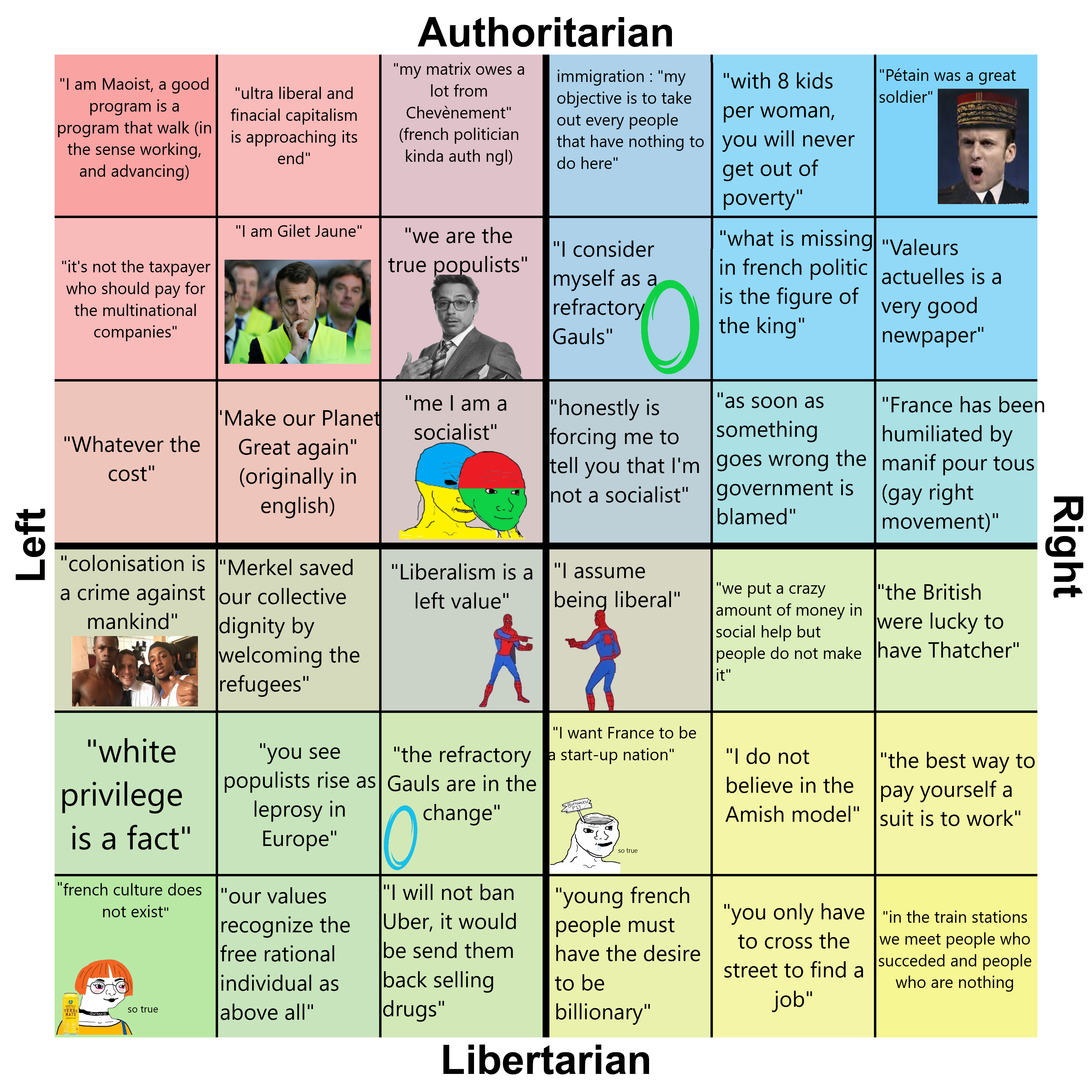
The voters born around 2008 will continue to elevate politicians like Trump, Macron, Fidias Panayiotou, Jordan Bardella, Giorgia Meloni, Jean-Luc Mélenchon or Călin Georgescu. What these people have in common is their ability to be heterodox without collapsing their own initial coalition (at least for a while).
In old politics we’d (correctly) call these people demagogues. But in contemporary politics that doesn’t mean anything anymore. Being, or at least being perceived as, a demagogue (by old times’ standards) is clearly not a losing proposition. And it’s even less relevant with voters under the age of 25.
This isn’t even the first time this happens in history. It’s just the first time it happens on such a wide scale. As we’ve been reminding everyone on the Sofa for over a decade: there are no new ideas. Just new propaganda, new methods of dissemination and new packaging.
The youngest politicians of 1776, 1789, 1848, 1878 or 1923 were not too different from the voters born in 2008: jaded with the status quo, out of fucks to give, openly in contempt to the status quo’s sacred cows and willing to experiment. This is both exciting and terrifying.
The scale now is different (and far more complex and difficult to manage), but the general ideas aren’t really that different. The large groups are still divided between imperialists (aka anti-nationalists), weaklings/socialists and self-determinationists (which includes nationalists, libertarians, militarists, etc.) which is really not that different from most of the debates of 1848.
But what’s unique about this time is that the large groups are a lot less coherent and amenable internally. The disagreements are a lot more pronounced (and oftentimes irreconcilable) because of the proliferation of microidentities and/or the death of big mainstream. And this is why increasingly heterodox politicians will make it. A politician like Adenauer, Reagan, Zapatero or Chirac would struggle in 2026 and would outright not be even in top 3 by 2030 (as demographic inertia picks up pace).
What do you offer?
Political campaigns were always about special interest groups and what you can offer to them. But from this point onwards, the map of interest groups has changed so radically that plenty of established political parties and institutions have effectively placed themselves on a collision course with the electorate.
The voter born in 2008 cares about things that matter but also cares deeply about things that are objectively irrelevant for the good governance of civilization. That’s how Fidias happened. He didn’t sell them Kremlin Cyrillic or antisemitism (which is what he does), but he sold them bitcoin, educational freedom and Youtube pranks. Turns out those mattered more. 1 in 5 Cypriots voted for this guy!
Similarly, you don’t get almost 50% among youngsters as a Republican by selling them on a new Iran deal, some tinkering in the fiscal code or even with anti-immigration talk. But you do get them votes with Kamala is for they/them. Establishmentarians on both sides scoffed at that ad but in the end that one mattered a lot more than pretty much everything else the GOP campaign did, as admitted by the opposition as well.
Well, all of this is about to be accelerated even more. By 2030 you’ll have an election winner somewhere in Europe, North America or the quasi-democratic part of Asia whose campaign discussed a topic that is not on anyone’s radar and that topic will be decisive. This is the new normal.
We can quibble about how things shouldn’t be this way or how too many voters under 25 (or even under 35 I’d argue) are terminally online losers who quite literally lack the maturity necessary to function but, ultimately, that’s a waste of time if you’re a political operative or candidate. You don’t have the time or the authority to even attempt to change any of this. Your job is to persuade them to vote for you (or your guy/gal if you’re the strategist).
You gotta go where they are
I don’t claim to have all the answers. I do claim, however, that most political analysts have even fewer answers than I do. In 2025 and 2026 I got to laugh a lot more at these people than ever before. Not even 2016 was as fun as the present. In 2016 the formerly mainstream operatives and analysts merely lost an election (long term that wasn’t even that consequential if we’re really honest). But in 2026 the very foundations of the profession and practice are being turned upside down.
And I’m here to warn you that it won’t get “better” (as in more like in the past). Quite the opposite. This soft balkanization will accelerate.
One way to adapt to this is to go where the voters are and see if you can fit. Or, if you don’t, see where they’re truly vulnerable. Every single niche/special interest has vulnerable points. They’ve been immune to any attacks so far because nobody attacked the vulnerabilities (because none of the mainstreamers had any idea how to find them).
Here’s a piece of free advice for all political sides: Nearly all niches have one or several turbonarcissists in their midst who is looking forward to publicize stuff on the internet.
The way to do political strategy has just gotten way more difficult, not only because it’s much more special interest groups to please, but also because it’s more dynamic. The winning move will be to find a way to replace some of the old groups (and by old I mean both in biological age terms and in institutional age terms) and to do so in such a way that doesn’t collapse your coalition. By the way, this isn’t easy at all.
We all get a front seat at the Democrats trying to do exactly that by replacing Jewish groups with terminally online antisemitic weirdos. Will it work? Well, so far it doesn’t seem to work (granted, it doesn’t help that they recruit weirdos who command zero respect even among those they claim to represent). But it could work in the future.
These days we see in Romania how the pseudo-progressive age 35-to-50, corporate waggies group is being unceremoniously excluded from power, its leaders arrested or barred and the general reaction is a shrug or a laughter. Or in Italy where FdL now relies on the support of the North while its traditional base in the South now shifts slowly because they’re upset their gibs were cut. Or in Peru recently where Ms. Fujimori won with the support of the wealthy (exactly the opposite from what her father achieved).
Realignments have happened before and will happen again. But how to manage them is not the same. This one will be harder than the previous one. Because the new(er) voters are way too different. Whoever doesn’t embrace the new heterodox way is bound to struggle in the next decade. Don’t say I didn’t warn you.
That is why at the Network we started several projects in 2026 that we explicitly didn’t talk about in public (and won’t anytime soon) with a view to stay ahead of the old guard. We won’t have all the answers, but the idea is to have more answers before everyone else so our Members know how to plan accordingly.
That’s it. It’s a fair warning. Discard at your own peril.

